
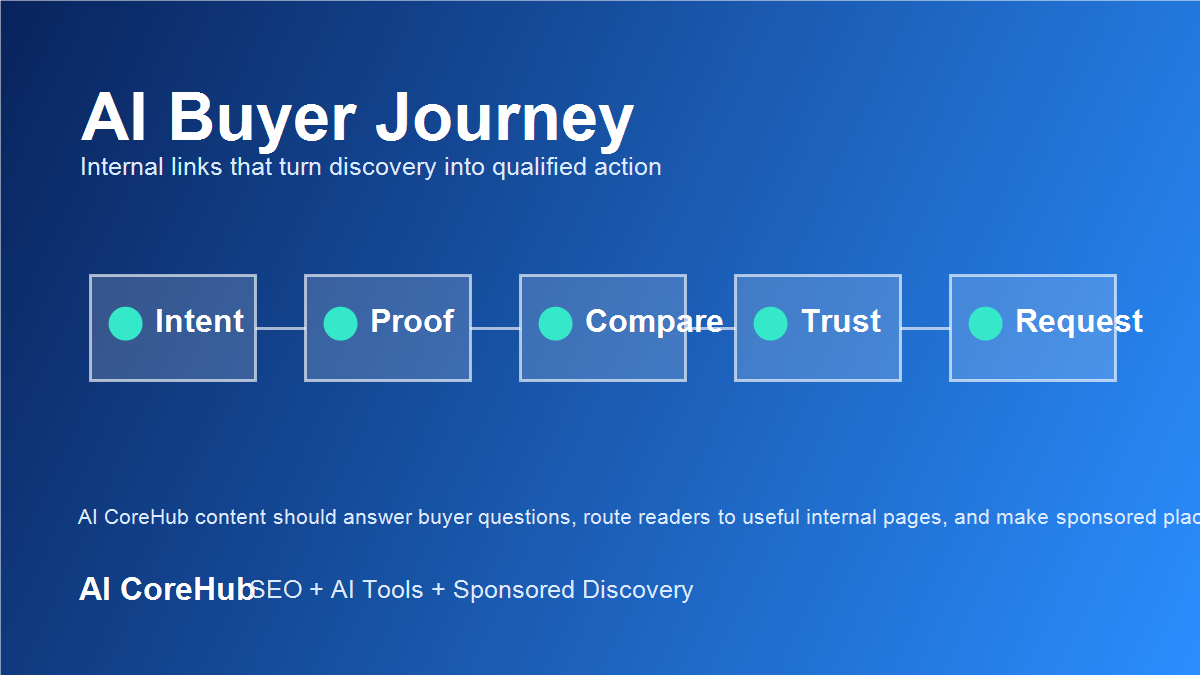
Why buyer journey internal links matter for AI discovery
AI buyers rarely make a decision from a single directory card. A founder, marketer, developer or SEO operator usually moves through several questions before they trust a tool recommendation or a sponsored placement. They want to know what the tool does, who it is for, what proof exists, how it compares with alternatives, whether it fits their workflow and what the next low-risk action should be. This is why internal links are not just a navigation detail. For an AI resource site, internal links are the route system that turns a casual visit into a buyer journey.
AI CoreHub should treat every strong article as a small decision hub. A reader who enters from search may begin with a guide, then move into the AI tools directory, compare curated options inside AI collections, read deeper context in AI news and insights, and only then consider a commercial path such as the backlink marketplace or advertising packages. When those steps are connected naturally, Google gets clearer topical signals and users get a more useful experience.
Who this is for
This article is for AI tool founders, SaaS marketers, content operators, SEO teams and agencies that want discovery pages to do more than collect impressions. The same framework also helps sponsored placement buyers understand whether their campaign has enough supporting context. A sponsored listing without internal routes is easy to miss. A sponsored listing supported by comparison pages, educational guides, proof notes and next-step calls to action can become part of a credible buying path.
The framework is especially useful when a site has many discovered pages but weaker indexing. In that situation, publishing more short posts is not always the best answer. The better answer is to strengthen a smaller set of canonical URLs so each page has a clear search intent, a visible audience, structured value, a relevant image, and internal links to the next useful page. A page that explains the decision process usually has more indexable value than a page that only lists names.
Practical use cases
The first use case is AI tool evaluation. A visitor reading about an automation platform should not be left at a dead end. The page should route them toward related tool categories, comparison collections and submission options. If a founder wants to be listed, the page can guide them to submit an AI tool after explaining what information makes a listing more useful: official URL, product category, screenshots, pricing context, use cases and proof points.
The second use case is sponsored discovery. A B2B SaaS advertiser does not only need a backlink; they need a credible placement path. The surrounding content should explain the target audience, the type of buyer intent, the internal pages that support the placement and the measurement plan. For example, a sponsored AI writing tool should be connected to relevant writing, productivity and workflow pages rather than placed alone in a generic ad block.
The third use case is index consolidation. When multiple pages compete for similar keywords, internal links can help identify the main page and support pages. The main page should receive the strongest contextual links, while smaller pages should add unique angles or be merged. This avoids shallow duplication and gives Google a cleaner reason to keep the canonical page in the index.
Evaluation checklist
Use this checklist before publishing or updating an AI buyer journey article. First, confirm that the title promises a specific outcome rather than a broad topic. Second, check that the slug is stable and keyword based, without a date suffix. Third, make sure the article includes a relevant image with descriptive alt text and a reliable HTTPS source. Fourth, keep the body content long enough to be genuinely useful, with at least 3000 effective characters. Fifth, include three to eight internal links that help the reader continue the journey inside AI CoreHub.
Sixth, review the commercial next step. The call to action should match the article’s intent. An educational AI workflow article may guide readers to explore more tools. A sponsored discovery article may guide advertisers to request a placement. A collection page may guide founders to submit a tool. The CTA should feel like a continuation of the advice, not a sudden sales pitch.
Seventh, verify that the body does not push users away through unnecessary external links. Official product links can belong in structured resource fields, but the SEO links inside the article body should support the site architecture. This keeps the article focused and helps AI CoreHub build stronger internal topical clusters.
How to choose internal links
Good internal links should answer the next question in the reader’s mind. If the current page explains buyer journey strategy, the next links should lead to tool discovery, collections, advertising options or deeper editorial guidance. The anchor text should be natural. Instead of repeating exact keywords, use phrases such as “compare curated AI tool stacks”, “review sponsor-ready placement options” or “continue with editorial AI insights”. This makes the page easier to read and reduces the risk of over-optimization.
Internal links should also balance SEO and revenue. A purely informational article can still support monetization when it routes qualified readers to the right commercial page. A commercial page can still support SEO when it explains buyer fit, boundaries and measurement. The goal is not to add links for their own sake. The goal is to connect intent, proof and action.
Next step
The next step for AI CoreHub is to keep improving a smaller number of strong canonical pages instead of creating many similar short URLs. For founders and advertisers, the practical path is simple: review the relevant editorial context, prepare proof assets, then choose the right commercial route. If the goal is product discovery, begin with the AI tools directory. If the goal is campaign exposure, review advertising packages or the backlink marketplace. If the goal is editorial contribution, prepare a useful tool submission with screenshots, categories and clear user value.
This approach supports both indexing and monetization. 搜索 engines receive stronger topical structure. Readers receive a better buying path. Sponsors receive clearer placement context. AI CoreHub receives pages that are easier to maintain, easier to improve and more likely to convert over time.
Indexable decision brief for AI Buyer Journey Internal Links for Sponsored Discovery
This AI CoreHub page has been expanded to make its search intent clearer for readers and search engines. The core topic is Ai Buyer Journey Internal Links Sponsored Discovery, and the practical purpose is to help a founder, marketer, product operator or SEO team understand whether this resource belongs in their workflow. This page should work as a standalone resource with a clear buyer question, not only as a short directory entry. Instead of functioning as a thin listing, the page now gives readers context, evaluation criteria, internal navigation and a commercial next step.
The page should be read as part of the wider AI tools directory and AI tool collections. Those sections help readers compare adjacent tools, category pages and workflow guides before they choose a product or request promotion. This internal route also helps Google understand how this URL connects to the broader AI CoreHub topical map.
Who this page is for
This resource is most useful for small teams that need practical AI software decisions without a long procurement process. It fits founders validating a new tool category, SEO teams building topical authority, content teams comparing workflow options and sponsors preparing evidence for a paid discovery campaign. The page is intentionally written for people who need a decision path, not only a quick definition.
For a tool, app, book, report or resource page, the most important question is not whether the name is familiar. The useful question is what job the resource helps complete, what proof a buyer should request and where the reader should go next. That is why this page now includes evaluation language, internal links and a clearer next-step path.
Practical use cases
Use this page when comparing AI resources for research, writing, design, coding, storage, reporting, automation or go-to-market work. A reader can use the summary to decide whether the topic is relevant, then move into related category pages for deeper comparison. If the page supports a commercial intent, the surrounding context should make the placement useful rather than interruptive.
For SEO and indexing, this page should answer a narrow buyer question in enough detail to deserve crawling and retention. Pages that only repeat a title, icon and short description are easy for Google to discover but ignore. A stronger page explains the target user, the workflow fit, the risks, the alternatives and the action a reader can take after reading.
Evaluation checklist
Before relying on this resource, check five things: the target audience, the workflow stage, the proof available, the switching cost and the next action. A practical AI resource should make at least one job easier. If it cannot explain the job, it is difficult for readers to remember and difficult for search engines to classify.
For buyer-ready pages, AI CoreHub prioritizes clarity over volume. The page should have enough original text, a stable URL, relevant internal links, useful headings and a credible CTA. It should avoid duplicate titles, thin body copy and isolated content that receives no internal support from the rest of the site.
Internal paths and commercial next step
Readers who want broader context can continue through AI News & Insights. Tool makers can prepare a submission through 提交AI工具. Teams interested in visibility, sponsored discovery or contextual placements can review the 外链推广市场 and 广告合作方案.
The commercial next step should be based on fit. A strong sponsor or tool submission should include the official URL, product screenshots, target audience, best use cases, proof points and preferred landing page. That makes the listing more useful for readers and gives AI CoreHub a better chance to publish pages that earn impressions, clicks and qualified inquiries.
GROW WITH AI COREHUB
Promote an AI tool or strengthen your SEO visibility
Turn this research traffic into business visibility with AI tool submissions, sponsored content and niche-relevant backlink placements.© 版权声明
文章版权归作者所有,未经允许请勿转载。
相关文章




暂无评论...