
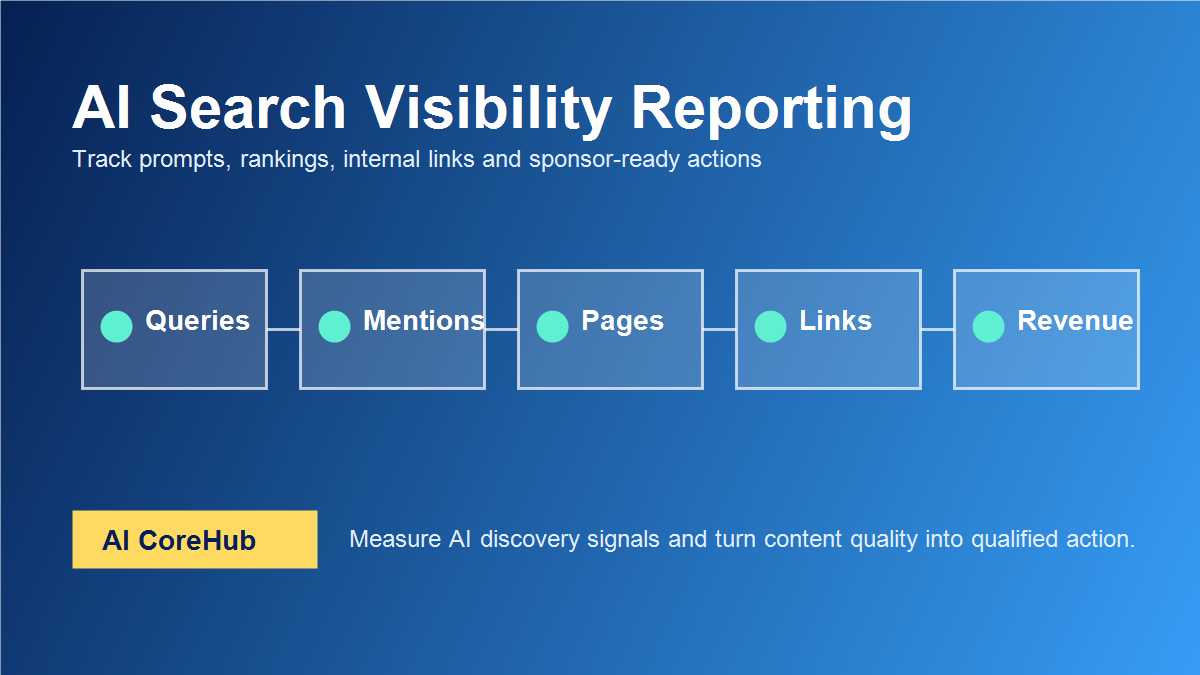
Why AI search visibility needs a reporting workflow
Small marketing teams are starting to track more than classic search rankings. They want to know whether their brand appears in AI answers, whether their pages explain the right buyer problems, whether internal links guide visitors to useful next steps and whether sponsored discovery pages can produce qualified action. Without a reporting workflow, those signals remain scattered. The team may publish content, check Google 搜索 Console occasionally, and still miss the connection between indexing, visibility and revenue.
AI CoreHub can use reporting content to connect editorial work with commercial outcomes. A reader can start with a visibility guide, continue into the AI tools directory, compare practical stacks through AI tool collections, read deeper context in AI News & Insights, and then evaluate commercial routes such as the 外链推广市场 or 广告合作方案. The reporting workflow should show how those pages support each other rather than treating every URL as a separate island.
Who this is for
This workflow is for small SEO teams, AI founders, agency operators, content marketers and SaaS teams that need a simple way to monitor visibility without building a large analytics department. It is also useful for sponsors who want to understand whether a paid placement has enough surrounding context. A sponsored page with no measurement plan is difficult to improve. A sponsored page connected to search intent, internal links, buyer proof and conversion actions can be reviewed and refined over time.
The workflow is especially important for newer sites that have many discovered pages but limited indexed URLs. In that case, the right response is not always to publish more short posts. The better response is to identify which pages deserve more depth, which pages should be internally linked more clearly, and which pages are too thin or repetitive. Reporting turns that decision into a repeatable process.
Practical use cases
The first use case is content quality tracking. A small team can review each new page against a simple checklist: stable keyword slug, unique title, useful image, at least 3000 effective characters, three to eight internal links, no unnecessary external body links, no noindex tag, clean canonical URL and a clear next step. This prevents thin pages from accumulating and gives every article a measurable quality baseline.
The second use case is AI visibility review. Teams can collect the questions they expect buyers to ask in AI engines, then compare those questions with the pages they have published. If a page cannot answer a natural buyer question, it may need a clearer section such as who this is for, practical use cases, evaluation checklist or how to choose. This helps AI CoreHub build content that is useful in long-context discovery environments.
The third use case is sponsor readiness. When a founder wants exposure, the team should evaluate whether the sponsor has enough proof: target audience, product URL, screenshots, use cases, pricing or access context, brand assets and success metric. If those inputs are weak, the placement may still be published, but it will be harder to write a trustworthy article. A sponsor-ready reporting workflow protects both revenue and editorial quality.
Evaluation checklist
Start with discovery metrics. Track which pages are crawled, indexed, clicked and shown in search. Then add page quality notes so the team can see whether indexing issues are related to thin content, weak internal links, missing images or duplicate themes. A spreadsheet or lightweight dashboard is enough at first. The important part is to review pages consistently and record what changed.
Next, track internal routes. Every strong article should guide readers toward another useful AI CoreHub page. The report should list the internal links used, the destination purpose and the CTA. A page that explains AI search visibility may link to tools, collections, insights and commercial pages. If the links are unrelated or repetitive, the page may feel optimized for bots rather than useful for readers.
Then track commercial fit. For informational pages, ask whether the article creates a natural reason to explore a tool, collection or deeper guide. For commercial pages, ask whether the article explains buyer fit, service boundaries, delivery expectations and measurement. For sponsor pages, ask whether the offer belongs in that context. This helps the site earn trust while still supporting revenue.
How to choose what to improve next
Do not improve pages randomly. Start with pages that are discovered but not indexed, pages receiving impressions without clicks, pages that support high-value commercial routes and pages that can become cornerstone resources. Add unique sections, improve the image, strengthen internal links and make the next step clearer. If two pages compete for the same idea, update the stronger page and consider consolidating the weaker one.
Small teams should also keep a record of published improvements. Each report entry should include the URL, update type, body depth, image status, internal link count, CTA, canonical status and any commercial note. This makes it easier to see whether quality improvements correlate with indexing, impressions or enquiries. The goal is not perfect attribution. The goal is better operating discipline.
Next step
The next step for AI CoreHub is to make reporting part of the publishing routine. Every new article should be checked after publication, then revisited if it remains discovered but not indexed. For founders and sponsors, the practical next step is to prepare better proof assets before requesting exposure. If the product has clear use cases, screenshots, audience notes and a measurable goal, it is easier to build a page that earns trust.
This reporting workflow turns AI visibility from guesswork into a manageable process. It helps editors choose what to update, helps sponsors understand what makes a placement credible and helps the site connect informational content with commercial paths. That is the kind of routine that can support indexing, rankings and revenue without flooding the site with low-value pages.
GROW WITH AI COREHUB
Promote an AI tool or strengthen your SEO visibility
Turn this research traffic into business visibility with AI tool submissions, sponsored content and niche-relevant backlink placements.© 版权声明
文章版权归作者所有,未经允许请勿转载。
相关文章





暂无评论...