Why sponsored discovery needs a launch checklist
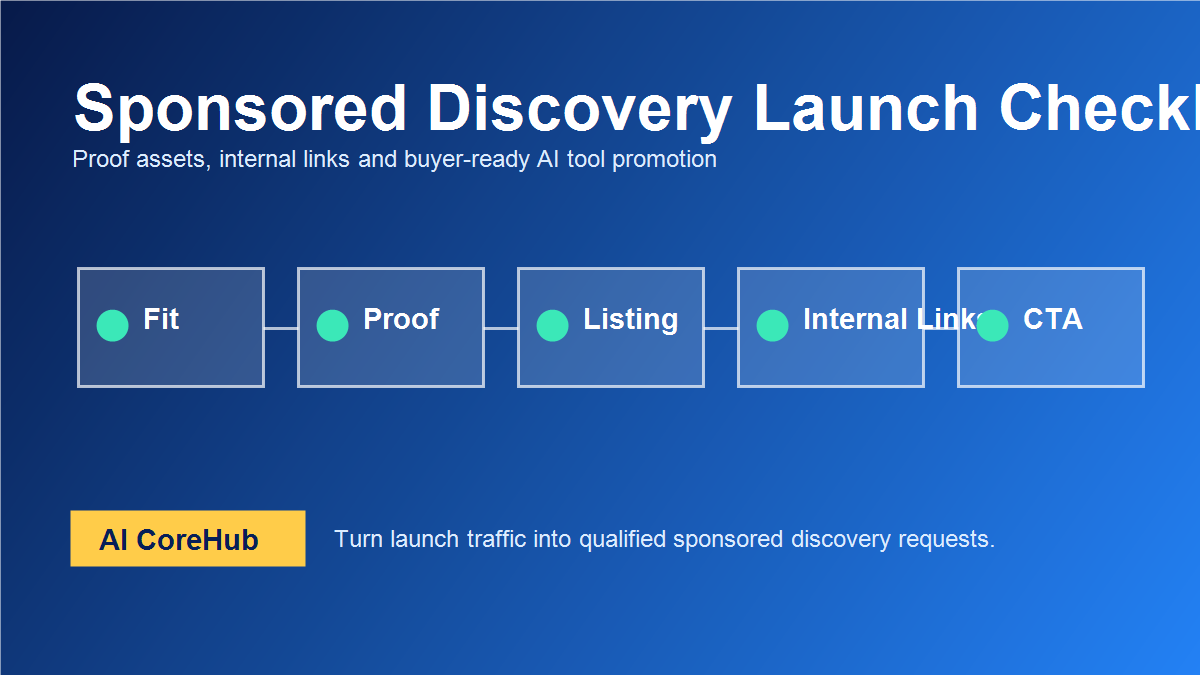
An AI tool launch can attract attention quickly, but attention alone rarely becomes qualified demand. Founders often prepare a product page, a short description and a logo, then expect a listing or sponsored placement to produce buyers immediately. The missing layer is usually buyer proof. A useful sponsored discovery campaign needs a clear audience, a defined use case, proof assets, internal links to supporting pages and a next step that matches the buyer’s level of intent.
AI CoreHub can support that path by turning each commercial article into a practical launch checklist. A reader should understand how to prepare for promotion, which proof assets matter, how a sponsored placement should be evaluated and where to continue inside the site. The ideal path may begin with the AI tools directory, move through relevant AI tool collections, continue into deeper AI news and insights, and then route qualified sponsors toward the backlink marketplace or advertising packages.
Who this is for
This checklist is for AI founders, SaaS marketers, product-led growth teams, agencies and SEO operators planning to promote an AI product through curated discovery pages. It is also useful for advertisers who want a sponsored listing but are not yet sure whether their product assets are strong enough. A good campaign should not rely on a generic ad message. It should give buyers enough context to understand who the tool is for, what problem it solves and why it deserves attention now.
The framework is especially helpful for smaller AI teams that do not have a large brand footprint. If a product is new, buyers need more reassurance. That reassurance can come from screenshots, demo flows, audience-specific use cases, comparison notes, pricing clarity, workflow examples and editorial context. When those pieces are connected through internal links, the sponsored placement feels more like a helpful discovery path and less like a disconnected advertisement.
Practical use cases
The first use case is a founder launching an AI productivity tool. The founder should prepare a concise product explanation, define the main audience, list the daily workflow problem, provide a screenshot or visual proof, and explain how the tool saves time. The article or listing should then link to relevant AI CoreHub pages that help the reader compare alternatives before making a decision. This makes the launch page useful even for visitors who are not ready to buy immediately.
The second use case is an SEO team buying sponsored discovery to support a backlink and brand visibility campaign. In this case, the campaign should not be measured only by the existence of a link. It should also be measured by placement relevance, internal routing, crawlable surrounding content, CTA clarity and whether the sponsor’s offer matches the audience. A placement connected to relevant content has a better chance of earning qualified clicks and supporting long-term search value.
The third use case is a tool directory submission. Before using 提交AI工具, the founder should prepare the official URL, category, short positioning, proof assets, feature summary and buyer use cases. A strong submission reduces editorial ambiguity and makes it easier to create a page that can stand on its own instead of becoming another thin directory card.
Evaluation checklist before promotion
Start with product fit. The tool should have a clearly named audience and a primary job to be done. A vague claim such as “AI for productivity” is weaker than a specific claim such as “AI meeting summaries for remote sales teams that need searchable follow-up notes.” Specific positioning helps both users and search engines understand the page.
Next, gather proof assets. A launch package should include at least one strong image, a simple workflow description, a short list of core features, pricing or access notes if available, and one example of how a buyer would use the tool. The image should be relevant to the product or campaign theme, served through HTTPS and given descriptive alt text. This improves user trust and avoids technical quality issues such as broken images or layout instability.
Then review internal routing. A sponsored discovery page should include three to eight internal links that help the reader continue. The goal is not to stuff keywords. The goal is to connect the buyer’s next question with a relevant AI CoreHub page. A reader may want to compare tools, read market context, inspect commercial placement options or submit a product for review. Each link should feel like a natural next step.
Finally, decide the conversion action. If the page targets founders, the CTA may invite them to submit a tool. If it targets advertisers, the CTA may route them to advertising packages or the backlink marketplace. If it targets researchers, the CTA may send them to deeper editorial insights. A single clear next step is usually stronger than several competing calls to action.
How to choose the right campaign page
Choose an educational article when the audience needs context before they are ready to act. Choose a collection when the buyer needs comparison. Choose a tool page when the user already knows the product category. Choose a commercial page when the reader is sponsor-ready and wants placement details, pricing logic, proof requirements or expected deliverables. Each page type has a different job, and the internal links should respect that job.
For AI CoreHub, the strongest monetization path is a cluster rather than a single page. A sponsor can be introduced through a useful guide, reinforced through a relevant tool category, supported by a collection and converted through a commercial page. This structure gives Google richer topical signals and gives buyers a more credible journey.
Next step
The next step for AI founders is to audit their launch assets before requesting paid exposure. Prepare the product URL, category, screenshots, use cases, proof points, ideal customer profile and success metric. Then choose the right AI CoreHub route: submit a tool for editorial discovery, review advertising packages for sponsored visibility, or use the backlink marketplace when the campaign is focused on SEO placement value. A campaign that starts with proof and routes users through useful internal pages is more likely to produce qualified action than a campaign that only asks for attention.
For AI CoreHub, this checklist should be reused as a quality gate for future sponsored placements. If a sponsor cannot explain audience, proof, workflow and next step, the placement should be improved before publication. That discipline protects the site from thin commercial pages, improves indexing quality and makes the advertising inventory easier to sell with confidence.
BACKLINK MARKETPLACE
Want a contextual backlink or sponsored placement?
Send your target URL, preferred anchor text and campaign goal. We can help with guest post inventory, sponsored listings and AI/SaaS launch visibility.© 版权声明
文章版权归作者所有,未经允许请勿转载。
相关文章



暂无评论...