
Why small SEO teams need a practical AI workflow stack
Small SEO teams do not need a giant list of artificial intelligence tools. They need a compact workflow stack that helps them move from research to execution without creating more operational noise. A three-person SEO team usually has to handle keyword research, content briefs, publishing, technical checks, reporting, client communication and sometimes paid promotion. If every task gets a separate tool with no shared process, the stack becomes slower than manual work.
The better approach is to choose a small group of tools around the buyer journey and the team’s daily workflow. AI CoreHub should help readers compare practical options inside the AI tools directory, then use curated AI collections to understand which tools belong together. A collection page should not simply say which tool is popular. It should explain when to use each tool, what proof to check, how the tools connect, and what the next business action should be.
Who this collection is for
This workflow stack is for small SEO agencies, solo operators, founders running content themselves and service teams that need to produce useful search assets without hiring a large editorial department. It is also useful for advertisers who want to understand how an AI tool might fit inside an actual SEO service workflow before buying a sponsored placement on AI CoreHub.
The collection works best for teams that already know the basics of SEO but need better speed and consistency. If a team has no content strategy, AI tools will not fix that weakness. But if the team already has target customers, service pages, keyword clusters and a publishing schedule, the right stack can reduce repetitive work and improve the quality of briefs, outlines, comparisons and client deliverables.
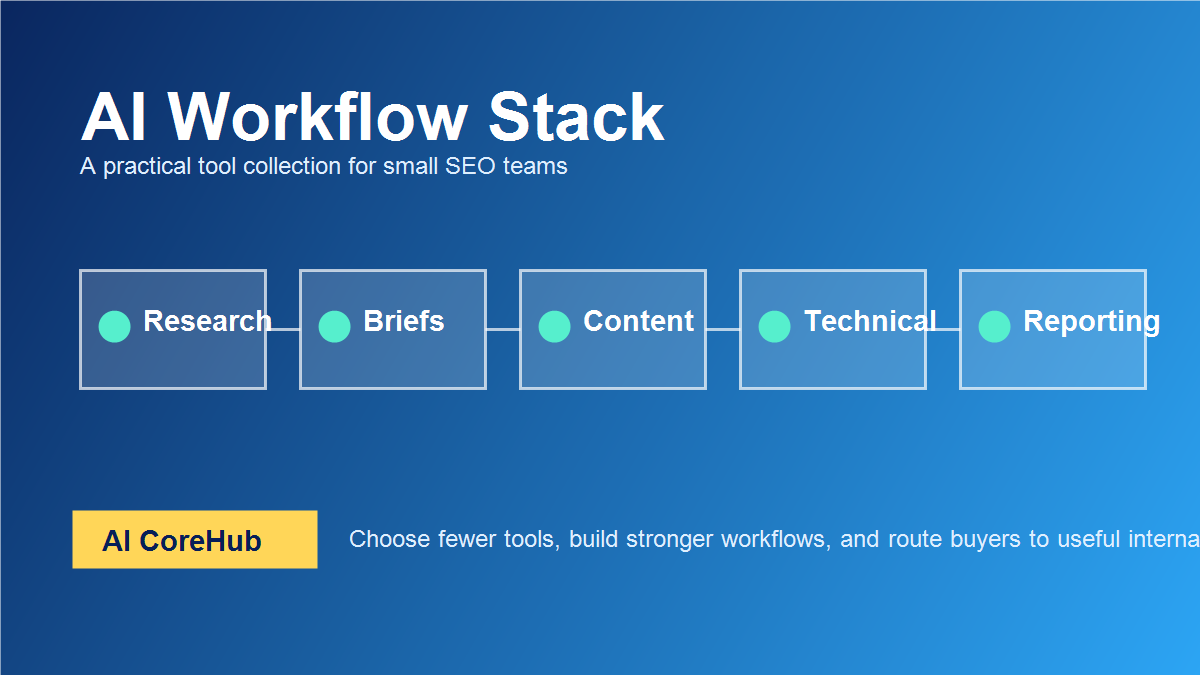
The five-part stack
The first layer is research. This includes keyword clustering, SERP analysis, competitor review, audience questions and search intent mapping. AI can help turn messy research into structured notes, but the operator still needs to decide which keywords are worth pursuing. A useful research tool should help the team identify patterns, not blindly generate topics.
The second layer is content briefing. A good brief should define the audience, search intent, main angle, internal links, proof requirements, image requirements, and CTA. This is where many small teams can create a competitive advantage. Instead of producing generic articles, the team can write briefs that connect search intent with a commercial outcome, such as a lead form, a tool submission, or a sponsor request.
The third layer is content operations. AI writing assistants can help draft sections, rewrite explanations and produce alternative structures, but the final article still needs human judgment. The team should review facts, remove repetition, add examples and make sure the article answers a specific buyer question. For AI CoreHub, that means every new article should have a clear path into AI News & Insights, a relevant collection, or a commercial page.
The fourth layer is technical QA. Before publishing, the team should check headings, title, meta description, image alt text, internal links, canonical URL, noindex status, mobile layout and mixed content. This is not glamorous work, but it protects the site from thin pages and technical errors that stop pages from performing. A page with a strong topic but broken images or weak internal links wastes crawl opportunity.
The fifth layer is reporting and commercial routing. Small SEO teams should track which articles attract clicks, which pages support conversions, and which topics create sponsor interest. For a site like AI CoreHub, reporting should connect editorial work with commercial inventory such as the 外链推广市场 and 广告合作方案.
Evaluation checklist
Before choosing an AI tool for the stack, ask five questions. First, does the tool save time on a recurring task, or does it only create a one-time novelty? Second, can the output be reviewed and improved by a human operator? Third, does the tool make the team’s SEO process more consistent? Fourth, does it create assets that can be reused in briefs, content pages, reports or sponsor materials? Fifth, does it reduce decision friction for buyers?
A strong tool should have a clear use case, a stable product page, understandable pricing or access details, and enough proof to trust it. A weak tool may have impressive messaging but no obvious place in the workflow. This is why collections should be built around jobs rather than hype. The best page for a small team is not “100 AI tools for SEO.” It is a focused explanation of which tools support research, briefing, writing, QA and reporting.
How to use this collection for monetization
This kind of collection can support monetization without becoming a hard sales page. The educational part helps readers make better decisions. The internal links then route commercial visitors toward the right next step. A founder with an AI tool can move to 提交AI工具. A sponsor can review advertising packages. An SEO buyer can evaluate the backlink marketplace. A reader who needs more editorial context can continue to AI News & Insights.
The strongest monetization signal is relevance. If a sponsored tool appears inside a workflow collection, it should match the job of the page. A writing tool belongs in briefing or drafting. A crawler belongs in QA. A reporting product belongs in measurement. When the placement matches the workflow, the sponsor receives better context and readers receive a more honest recommendation environment.
Next step
The next step is to audit the team’s current AI stack and remove anything that does not support a recurring workflow. Keep the tools that improve research, briefing, content production, technical QA and reporting. Then build internal pages that explain the workflow clearly, include useful images, and guide readers to the next AI CoreHub page. For sponsors, the best request is not simply “place my link.” It is a prepared package with audience fit, screenshots, use cases, proof assets and a clear success metric.
AI CoreHub should continue building collections like this because they sit between informational search and commercial action. They help Google understand topic clusters, help readers choose tools, and help advertisers see where sponsored discovery can fit naturally. That is the kind of content that has a better chance to index, rank and convert over time.
GROW WITH AI COREHUB
Promote an AI tool or strengthen your SEO visibility
Turn this research traffic into business visibility with AI tool submissions, sponsored content and niche-relevant backlink placements.© 版权声明
文章版权归作者所有,未经允许请勿转载。
相关文章



暂无评论...