
AI Research Tool Stack for Content Discovery and Buyer Intent
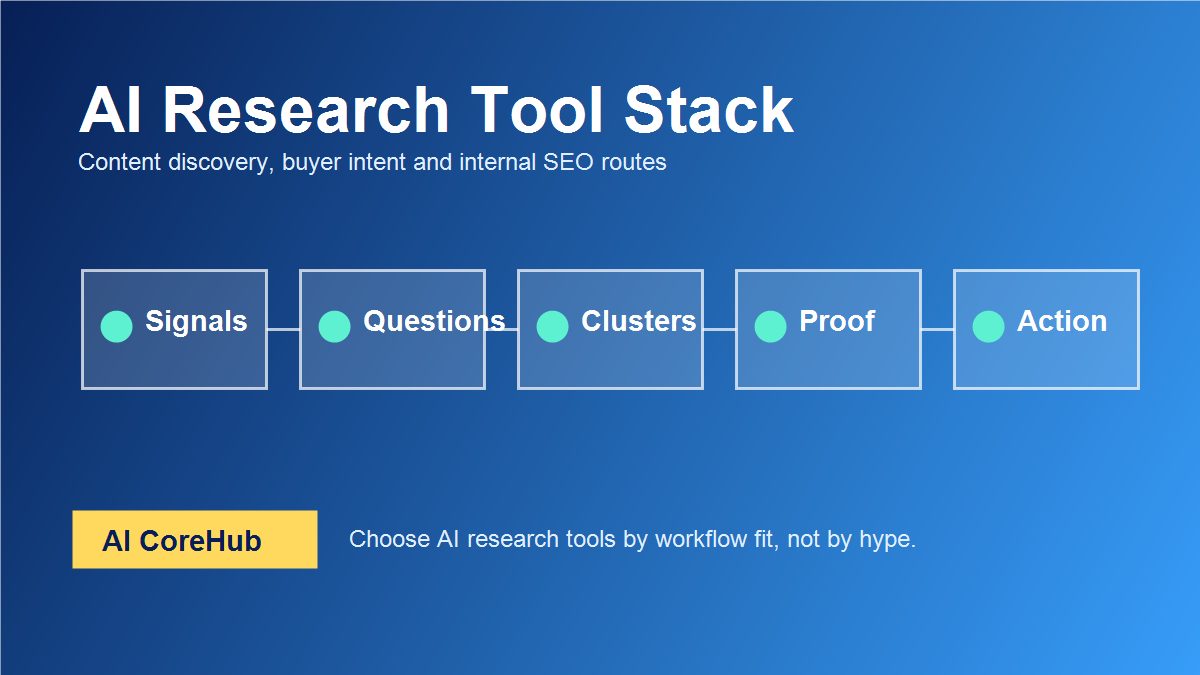
Why AI research tools need a workflow, not a random stack
AI research tools can make an SEO team faster, but only when they are placed inside a clear workflow. A random stack creates duplicated notes, repeated content ideas and shallow pages that do not help search engines or buyers. The better approach is to start with the buyer question, map the search intent, collect proof, then route the reader toward a useful next page inside AI CoreHub. This makes the article useful for search visitors and commercially useful for founders, advertisers and service teams.
For AI CoreHub, the research stack should connect editorial discovery with business outcomes. A reader may enter through a guide, continue to the AI tools directory, compare options inside AI tool collections, read supporting context in AI News & Insights, and eventually review the 外链推广市场 or 广告合作方案. That path gives every article a role in both topical authority and revenue conversion.
Who this guide is for
This guide is for small SEO teams, AI founders, content operators and SaaS marketers who need to discover practical topics before publishing. It is also for advertisers who want to understand whether their product can fit naturally into a curated AI discovery environment. The goal is not to recommend every popular tool. The goal is to define the research jobs that matter before choosing software.
The most useful AI research stack helps teams answer five questions. What are buyers trying to solve? Which queries show high intent? What evidence would make a recommendation credible? Which internal pages should support the topic? What commercial next step should appear after the educational content? If the stack cannot answer those questions, it may be impressive software but weak operational infrastructure.
Practical use cases
The first use case is topic discovery. AI tools can help collect customer questions, cluster search intent and identify patterns across competitor pages. But the team should still decide whether a topic deserves a full article, a collection, a tool page or a commercial landing page. This decision prevents thin pages from multiplying and protects crawl quality.
The second use case is buyer-intent mapping. A topic such as AI writing tools may serve many audiences: founders, agencies, students, marketers and support teams. A good research process separates those audiences and chooses one specific angle for each page. That creates more useful content and helps avoid several pages competing for the same keyword. Internal links then connect the related angles without forcing every article to repeat the same information.
The third use case is proof collection. AI-generated summaries are not enough. A useful article should include evaluation criteria, workflow fit, screenshots or images, limitations, service boundaries and a next step. If the topic is commercial, the article should explain how a sponsor or tool founder can prepare better assets before using 提交AI工具 or requesting a sponsored placement.
Evaluation checklist for AI research tools
Start by checking whether the tool supports repeatable work. A good research tool should help the team collect questions, cluster themes, compare intent and create brief-ready notes. It should not only generate attractive text. The best output is something an editor can verify and turn into a stronger page.
Next, check whether the tool improves decision quality. If the tool gives many ideas but no prioritization, the team still has to do the hardest work manually. Look for features that help compare demand, buyer fit, content difficulty, SERP patterns and commercial value. For a site like AI CoreHub, commercial value includes whether the article can support a sponsor, a tool submission, a comparison collection or a backlink marketplace page.
Then review publishing readiness. A topic is not ready until it has a stable keyword slug, a clear title, a useful image, enough body depth, natural internal links and a CTA that matches intent. If any of those pieces are missing, the page may be discovered by Google but still struggle to earn indexing or rankings.
How to choose the right AI tool category
Choose research tools when the team needs better topic selection. Choose writing tools when the brief is already strong but drafting is slow. Choose image tools when the page needs a distinctive visual that matches the title. Choose technical tools when layout, speed, canonical tags or broken assets are the problem. Choose reporting tools when the team needs to connect content work with traffic, leads and sponsor interest.
The strongest stack is usually small. For many small teams, five capabilities are enough: research, briefing, drafting support, visual creation and QA. A larger stack can be useful later, but only after the workflow is stable. AI CoreHub should continue presenting tools through practical workflows, because buyers search for outcomes, not just product names.
Next step
The next step is to audit one existing content workflow and identify the weakest stage. If topic ideas are weak, improve research. If drafts are generic, improve briefing. If pages are not indexed, improve depth, internal links and image quality. If traffic does not convert, improve the CTA and connect the article to relevant commercial pages. This gives AI CoreHub a clearer editorial and monetization path.
For founders and advertisers, the action is equally simple: prepare a buyer-focused product story before asking for exposure. A strong submission should include the official product URL, category, use cases, proof assets, screenshots, target audience and success metric. With those pieces ready, a listing or sponsored placement can become part of a credible discovery journey instead of a disconnected promotion.
GROW WITH AI COREHUB
Promote an AI tool or strengthen your SEO visibility
Turn this research traffic into business visibility with AI tool submissions, sponsored content and niche-relevant backlink placements.© 版权声明
文章版权归作者所有,未经允许请勿转载。
相关文章


暂无评论...